
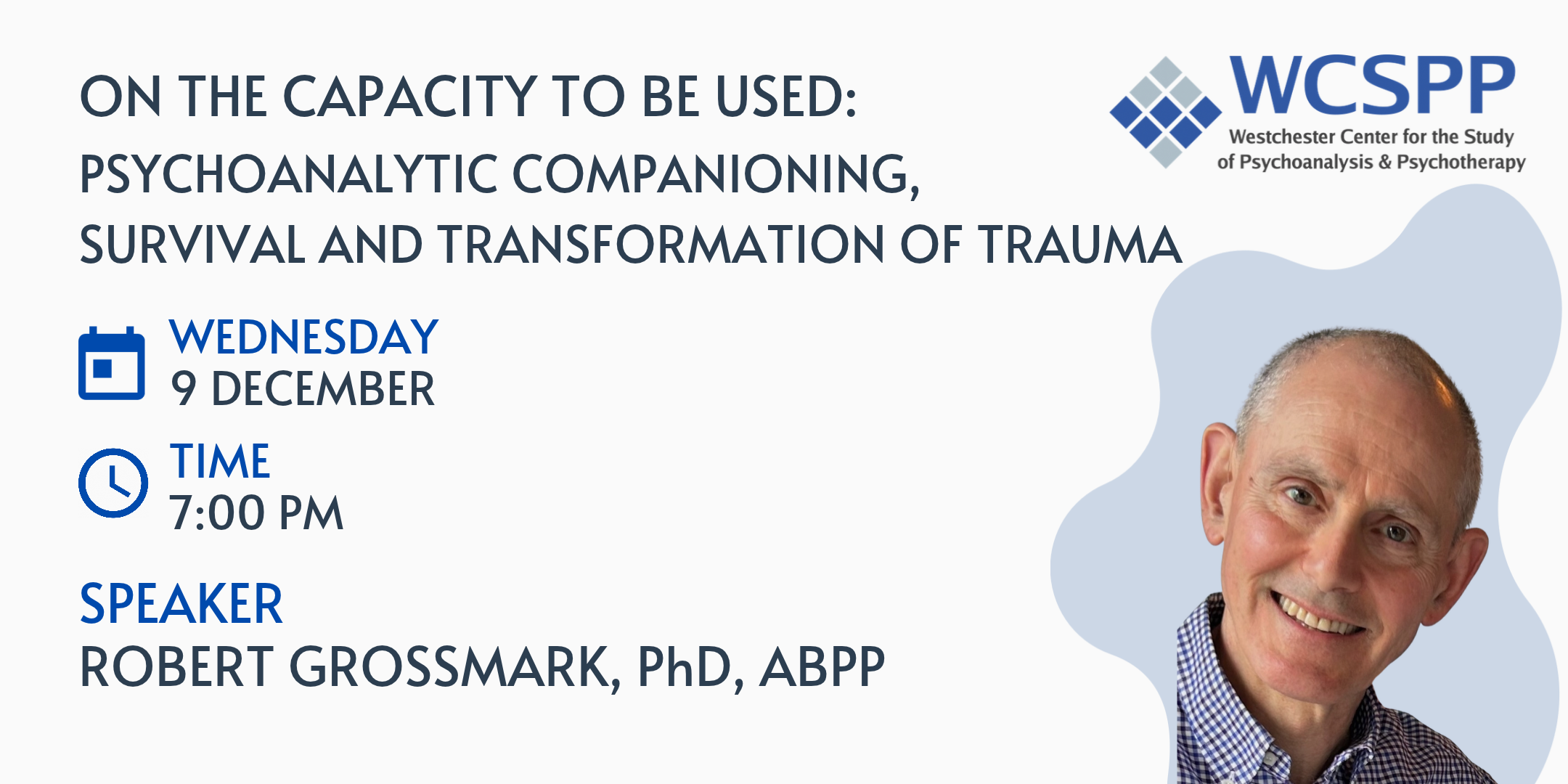
On the Capacity to be Used: Psychoanalytic Companioning, Survival and Transformation of Trauma
2 CE Hours available for:
NY Practitioners – LCSWs, LMSWs, LPs, LMFTs, LMHCs, LCATs, PHDs, PSYDs
CT Practitioners – LCSWs, LMSWs, LMFTs, LPCs and Licensed Psychologists (pending)
Psychoanalysis in Action
On the Capacity to be Used: Psychoanalytic Companioning, Survival and Transformation of Trauma
Presenter:
Robert Grossmark, PhD, ABPP
In his paper “The Use of an Object and Relating Through Identifications” Winnicott famously stated that “To use an object the subject must have developed a capacity to use objects.” In this paper I suggest that likewise, in order to help patients who suffer the sequelae of early developmental trauma make use of the object of the treatment the analyst or therapist must develop the capacity to be used. I will lean on Winnicott and others to reflect on the profound transformational and healing processes that can unfold when the patient is companioned and known in their primary agonies and unrepresented states such that the breakdown that was never experienced can finally take form and be represented and experienced. Unmetabolized trauma does not find form in symbolization but rather manifests in the dimension of mutual enactment. Thus, rather than view enactment as an impediment to the therapeutic process I embrace it as the most profound non-symbolized expression of inner pain and agony and hope to illustrate with case material how that very pain and fear can be transformed when known and survived in mutual enactment. This work makes great demands on both therapist and patient, and I hope that the case material I will share captures the profound struggle for both parties along with the profound psychological transformations that emerge.
Live on Zoom!
ROBERT GROSSMARK, Ph.D, ABPP is a psychoanalyst in New York City. He works with individuals, groups and couples and conducts psychoanalytic consultation and study groups.
He teaches and supervises at the New York University Postdoctoral Program in Psychotherapy and Psychoanalysis, The National Training Program in Psychoanalysis, The Institute for Psychoanalytic Training & Research and lectures nationally and internationally. He is an Associate Editor for Psychoanalytic Dialogues.
He is the author of The Unobtrusive Relational Analyst: Explorations in Psychoanalytic Companioning and co-edited The One and the Many: Relational Approaches to Group Psychotherapy and Heterosexual Masculinities: Contemporary Perspectives from Psychoanalytic Gender Theory.
Moderated by:
Adrienne Katzow, PhD and Deborah Levin, PsyD,
Co-Chairs of Psychoanalysis in Action, WCSPP
CLICK HERE TO REGISTER!
The WCSPP community is invited to a book discussion on Zoom. Watch the listserv for more information!
Watch the listserv for the Zoom link!
Watch the listserv for the Zoom link!
2 CE Hours available to NYS LCSWs, LMSWs, LPs, LMFTs, LMHCs, LCATs, Psychologists and PsyDs
Watch the Movie Sentimental Value before the Event – – then Join Us to Discuss!
You can stream the movie on many platforms including Hulu, Amazon Prime, Apple TV, and YouTube.
Please join us for a discussion of Sentimental Value (Norway, 2025) an award-winning film that touches on themes of memories associated to place, life phases, intergenerational trauma, familial estrangement and reparation, and many rich layers of creative process.
Sisters Nora and Agnes reunite with their estranged father, the charismatic Gustav, a once-renowned director who offers stage actress Nora a role in what he hopes will be his comeback film. When Nora turns it down, she soon discovers he has given her part to an eager young Hollywood star. Suddenly, the two sisters must navigate their complicated relationship with their father — and deal with an American star dropped right into the middle of their complex family dynamics.
A discussion will be facilitated via ZOOM by Bonnie Allie, LCAT, LP
(Bonnie) Yvonne Allie, LCAT, LP, is a child and adult expressive arts psychotherapist and supervisor in private practice since 1985. Trained at Pratt Institute and the New Hope Guild, her extensive background includes specialized psychoanalytic mentorship with Arthur Robbins, Pierre Boenig, Pamela Sorenson, and Dr. Tom Menaker, alongside former adjunct faculty roles at the College of New Rochelle. An active member of both IEA and WCSPP, she spends her free time painting and writing stories.
Sign up to join us!
REGISTRATION LINK
Join us at Manhattanville University or by Zoom!
5 CEs for most NY and CT licenses
Conference Overview
This conference will focus on the intersection of therapist’s and patient’s subjective experiences. The wish to rescue and heal our parents is a widely recognized catalyst for choosing to become a therapist. However, the ongoing presence in the treatment room of not only the patient’s but also the therapist’s internal objects, a phenomenon that influences choice of theory, therapeutic technique and specific interventions is so ubiquitous (or imagined to have been thoroughly analyzed) that the implications are not always well-enough examined or understood.
Dr. Steven Kuchuck has written and presented extensively on the topic of the therapist’s subjectivity. He will deliver a paper describing his work with a patient traumatized by toxic, fragile objects in treatment with an analyst similarly impacted by parental fragility. He will consider a period of existential crisis for both parties in which events overlapped, finality hovered, and confusion enveloped the dyad. Senior analysts and discussants Hillary Grill, LCSW, and Rachel Sopher, LCSW, will help illuminate clinical and theoretical nuance and deepen the broader conversation.
In addition, Dr. Kuchuck will respond to a paper presented by Cara Maniaci, LCSW, exploring the impact of idealizing transference in psychoanalytic action. Maniaci builds on the concept of idealization as a point of identification and desire, and looks at how the resolution or mourning of an idealized transference between patient and analyst enables self-recognition. Her paper examines this process from various vantage points – using clinical material from her work with patients and drawing from her own experience as an analysand.
Click here for full brochureRegistration link to attend IN-PERSONRegistration link to attend on ZOOM
Speaker Biographies
Dr. Steven Kuchuck is former Editor-in-Chief of Psychoanalytic Perspectives, where he currently serves as Senior Consulting Editor; Past President of the International Association for Relational Psychoanalysis and Psychotherapy (IARPP); current Editor of Routledge’s Relational Perspectives Book Series; and faculty, NYU Postdoctoral Program in Psychotherapy and Psychoanalysis, NIP National Training Program, and other institutes. His book, The Relational Revolution in Psychoanalysis and Psychotherapy, has been translated into numerous languages. He won the Gradiva Awards for best book of 2015 for Clinical Implications of the Psychoanalyst’s Life Experience and in 2016 for The Legacy of Sandor Ferenczi: From Ghost to Ancestor. His most recent book, The Workbooks of Masud Khan: Diary of a Fallen Psychoanalyst (co-edited with Linda Hopkins), is published by Karnac Books.
Cara Maniaci, MA, LCSW, is a 2026 graduate of the Advanced Program in Psychoanalysis at WCSPP. She has completed a two-year program in Relational Psychoanalysis at the Stephen Mitchell Center for Relational Studies. She is also a graduate of WCSPP’s Couples Therapy Training Program. Cara has written for The American Psychoanalyst and Psychoanalytic Quarterly. She is an active member of APsA’s President’s Commission on Artificial Intelligence. Cara has a private practice in Pleasantville, NY, working with adults, adolescents and couples.
Hillary Grill, LCSW, is a psychoanalyst practicing in New York City. She is a supervisor, faculty member and training analyst at the National Institute for the Psychotherapies and the Institute for Expressive Analysis. She is on the faculty and supervises at the Stephen Mitchell Relational Study Center. She writes and presents widely and is executive editor of the journal Psychoanalytic Perspectives. Areas of interest are the psychological aspects of women’s reproductive health, contemporary family-making, the impact of the socio-cultural environment on the individual and the genesis of creativity.
Rachel Sopher, LCSW, is Faculty and Supervisor, National Institute for the Psychotherapies Training Institute (NIP); Faculty and Supervisor, NIP’s National Training Program; and Faculty and Supervisor and on the Executive Committee of The Stephen Mitchell Relational Study Center. She is co-Editor with Amy Schwartz-Cooney of the collection Vitalization in Psychoanalysis and Senior Editor of Psychoanalytic Perspectives. She writes and presents on reaching nonverbal states and vitalizing interactions in the psychoanalytic encounter and maintains a private practice in New York City.
Moderator – Carter Thornton, LCAT, LP, LPC, is a Psychoanalyst and Creative Arts Therapist in private practice in New York. He is faculty and clinical supervisor at Institute for Expressive Analysis, and is an instructor and co-chair of the film committee at the Westchester Center for the Study of Psychoanalysis and Psychotherapy. He is also a Zen practitioner, a working musician, and a visual artist.
2 CE Hours available for:
NY Practitioners – LCSWs, LMSWs, LPs, LMFTs, LMHCs, LCATs, PHDs, PSYDs
CT Practitioners – LCSWs, LMSWs, LMFTs, LPCs and Licensed Psychologists
Presented by WCSPP’s Child, Adolescent, Parent (CAPP) Psychotherapy Training Program
Parenting in Today’s World: Clinical Conversations
The Art and Science of Parenting and Grandparenting:
Raising Emotionally Healthy Children in a Challenging World
American children and American families are in crisis. Families are facing extreme stress, and our children, by almost every metric, are not doing well.
Helping our children and grandchildren succeed in life is less about teaching skills and more about having better conversations; less about earning rewards and more about learning to cope with painful feelings; less about individual achievement and more about helping others; less about clearing a path to success and more about strengthening an inner feeling of confidence and pride.
In this talk, Ken Barish, PhD, will offer guidance on many of the most important concerns of contemporary parents and grandparents: How we can protect our children’s emotional health, support their love of learning, solve family problems, and nurture feelings of empathy and kindness toward others. He will present practical suggestions for how, as parents and grandparents, and as child therapists, we can strengthen the quality of our family relationships and remain a vital source of encouragement and emotional support for our children and grandchildren.
Live on Zoom!
Ken Barish, PhD, is a graduate and faculty member of the Westchester Center for the Study of Psychoanalysis and Psychotherapy. He is also on the faculty of the William Alanson White Institute Child and Adolescent Psychotherapy Training Program. Ken is Clinical Professor of Psychology at Weill – Cornell Medicine and Visiting Professor at Tongji Medical College in Wuhan, China. He is Associate Editor of the Journal of Infant, Child, and Adolescent Psychotherapy and a Fellow of the American Psychological Association.
Ken is the author of How To Be A Better Child Therapist: An Integrative Model for Therapeutic Change. He also wrote a book on political dialogue, Bridging Our Political Divide: How Liberals and Conservatives Can Understand Each Other and Find Common Ground. Bridging Our Political Divide is winner of the 2025 International Book Award for Current Events.
Ken’s most recent book is The Art and Science of Parenting and Grandparenting: Raising Emotionally Healthy Children in a Challenging World.
In addition to his teaching, writing, and clinical practice, Ken plays jazz trumpet.
CLICK HERE TO REGISTER!
Save the date! Watch the listserv for more details.
The Spring Trimester begins. The complete list of dates can be found on the Academic Calendar in the Member Portal.
The Winter Trimester begins.The complete list of dates can be found on the Academic Calendar in the Member Portal.